|
||||||||||
 |
Five Generations Of Canterbury Contracting
Errol Hadfield reckons that agricultural contracting is in his genes. For good reason: Errol's father, grandfather, and great grandfather - who immigrated to Canterbury from the village of Hadfield, Derbyshire, England, in 1862 - were all contractors. Errol's father, Alan, helped build the Lewis Pass road from the summit to the Hanmer turn-off during the depression years in the 1930s, and he later bought a 300-acre dairy and cropping farm in Ellesmere, Canterbury.
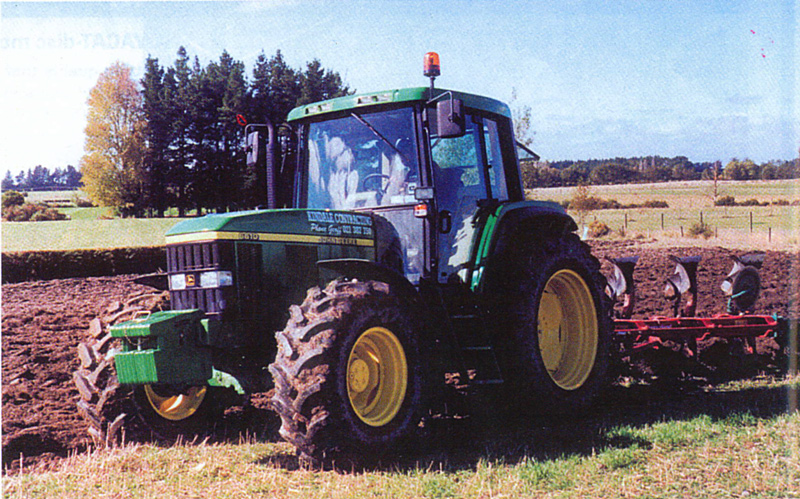
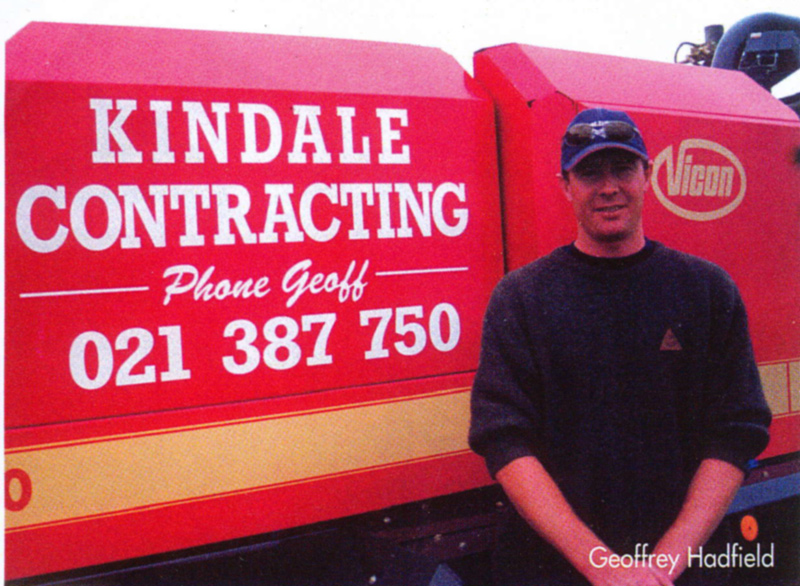
To get his start, Errol worked as sheep shearer and wool classer in Australia for three years. He saved money for his first farm, and in 1960, he bought his parent's farm. By 1973 Errol and his wife, Kaye, had outgrown the Canterbury farm and were looking for a new challenge. They decided to make a dramatic change in their lives. They sold the Ellesmere property and bought60 acres of land in the Omaka Valley near Blenheim, which they started developing into a vine-yard in 1975. "Grape growing was very new then, so it seemed a bit of a risk to go into viticulture at the time," Errol says. But as time has shown, that risk soon proved to be very successful, and the vineyard prospered. Over the next 25 years, the Hadfields reared their four children (three sons and a daughter) and grew a range of grape varieties for their own label, 'Kindale', as well as for Montana. In addition to working their own grapevines, they managed other vineyards and offered viticultural contracting services in the Marlborough region. "My wife, Kaye, fielded telephone calls and worked in the vineyard," Errol says. "She also developed and maintained a large garden around the house, which was at times on display and open to the public. The children grew up with viticulture and were very helpful throughout those 25 years with the installation of trickle irrigation and running out wires for the hundreds of rows of trellis." Looking back, Errol says he could not have done it without their help. The Hadfields sold their vine-yards to Ngai Tahu two years ago and last year bought 100 acres of land back in Canterbury, the territory of Errol's ancestors. Errol and Kaye still live in Blenheim while their eldest son works in London, and another son and daughter live in Christchurch. "The youngest, Geoffrey, was the only one keen to work in agriculture. He has a keen knowl-edge of machinery and is a seal asset for the new business," Errol says. Now semi-retired, Errol and Kaye work with Geoffrey to run Kindale Holdings Ltd., a North Canterbury cattle farming and contracting business at Summerhill. Geoffrey handles the day-to-day operation of the contracting and farm, while Errol does overall management, keeps the books and finds his way to Summerhill once a fortnight to do a stint on the tractor now and again. The Hadfields recently bought another 100 acres joined to the original land by a 900 metre pa-per road which they've opened for access between the properties. "It was interesting to open up that road," Errol says. "It had to be surveyed and fenced. I'd never done it before yet it was the kind of contracting my father and grandfather had worked in all those years ago." Kindale Holdings Ltd. runs about 200 head of cattle on the two properties and offers a range of agricultural services in baling, ploughing and cultivation throughout Ohoka, Fernside, Rangiora, and Oxford. They feed their cattle wrapped silage from their own land at Summerhill and buy some in as well. "Eventually, I would like to increase the number of cattle with improved fencing and new pasture together with supplementary feeding," Errol says. When the Hadfields changed from viticulture to their present operation, they invested in a whole new fleet of machines through Chris Clifford, manager of Farm Machinery and Repairs in Blenheim. Though they originally brought their John Deere 1640 tractor down from Blenheim, where they'd used it to work in the vineyards, Errol says they decided to trade it for a John Deere 6200 to suit their new contract-ing needs. The 6200 is a four-wheel drive and has a front-end loader for stacking bales. It is also used for mowing and side raking.
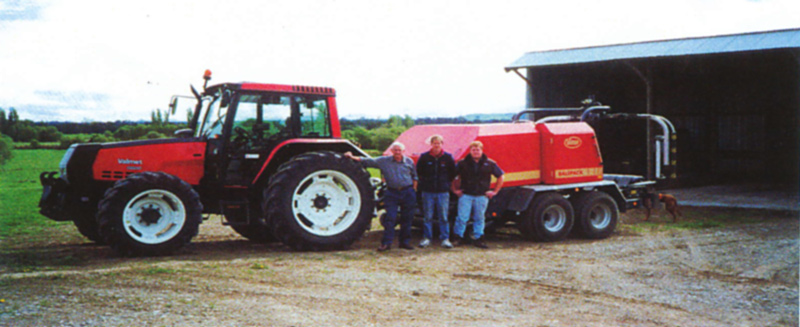
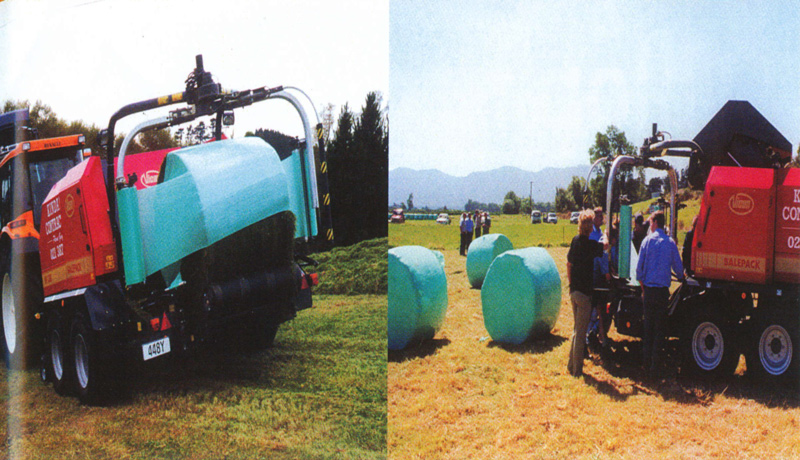
Their larger tractor is the John Deere 6610, a four-wheel drive with plenty of power, 120hp, to run their new Vicon Balepack baler. When it's his turn for a stint in the tractor seat, Errol relishes the opportunity. "It's a bit of that 'boys with their toys' idea, I guess, but the cab in the new 6610 is comfortable with the air conditioning, computerised functions, and even a CD player - it's great to use. "Seriously, though, I think it's important to have good equipment because people are going to get away from buying their own machinery - it's too expensive for each farmer to buy his own." Indeed, it was Kindale's top of the line equipment that first attracted their initial customer. style="text-align: center;" "Our first client came to us," Errol explains. "They saw the Vicon baler in the shed and were impressed. So we did work for them that year, along with about 15 other clients. They have all come back to us again this year." Last year the Hadfields' Vicon Balepack was the only one in the South Island, though there are now two or three other ones, Errol says. "The baler is a real time-saver because it does the baling and wrapping in one pass," he says. It gathers hay and forms the bale in a chamber then loads it onto the wrapping table. Once wrapped, it is then gently lowered onto the ground, he explains. Errol says they also appreciate the ability to choose the bale density and the option of omitting the plastic wrap if required. Wrapped silage is easily stored, and each bale is a sealed unit that generally has a higher-quality dry matter content than bulk silage. Also, the likelihood of effluent seepage is extremely small. Wrapped silage is easily transportable and therefore can be sold in cases of surplus. It can prove invaluable when summer grass is in short supply. For their other baling needs, the Hadfields use the Hustler Chainless 2000 bale feeder and the Rata Bale Handler, equipped with soft hands to stack the 800 kg bales after they've been wrapped.
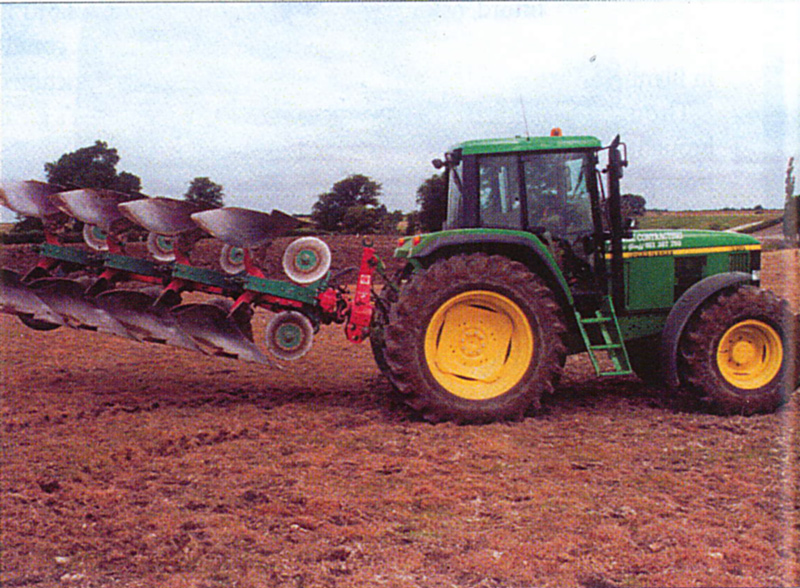
At the start of the season, the Hadfields enjoy the features of a new plough, the reversible, variwidth Kverneland EC. "With this plough there's no more of the old idea of having strikeouts and sometimes deep plough finishes, Errol explains. "Because the plough is reversible with a 3-point linkage, we can start on one side of the paddock, get to the headland and the plough turns itself over to do the next trip back. There's a roller called a Pac-a-Mat, which is attached to the side and swings 180 degrees, to roll the furrows down while you are ploughing. We can also adjust the width so that when we are in good ploughing conditions we can have wide furrows."
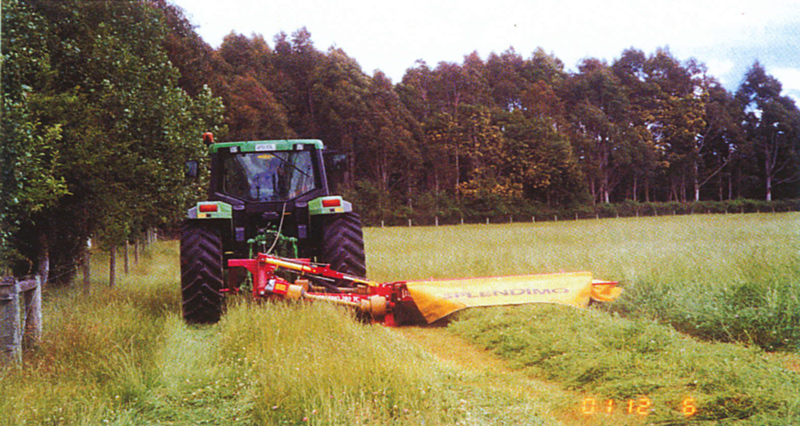
The Hadfields also run a Kvemeland TLA cultivator. Their mower/conditioner is a new 2.8 meter Lely Splendimo 280 TC. "When conditions are right, and we get a heavy crop, we don't even need to use the rake, the mower does the job. We rake only when there is a light crop," Errol says. After mowing, and in good weather conditions, Errol says they leave the crop to wilt from 24 to 36 hours which makes high-quality wrapped silage. When raking is required, the Hadfields use their Slam V10, which "doesn't rope the row and gives a smooth feed into the baler." Clients of Kindale Holdings Ltd. are a mix of dairy and deer farmers, some of whom produce up to 1,000 bales on their land. The company also has a few client who own lifestyle blocks. "There are people with 20 acres of land who don't know what to do with their surplus grass. So we harvest it and then buy the wrapped silage off them for our cattle," Errol says. To keep up with the demand, the Hadfields have now engaged a semi-retired farmer to work part-time. But Errol says he thinks the demand for Kindale services will continue to expand. "People hear about our work, and we have advertisements in the yellow pages and newspa-per," he says.Just as well, because an in-creased demand means Errol might just have to get on that John Deere 6610 a bit more. Judging from the way Errol's eyes light up when he speaks about the tractor, this is a pleasing pros- pect.
Errol Hadfield says it was his company's top of the line equipment that first attracted their initial customer. "Our first client came to us," Errol explains. "They saw our Vicon Balepack baler in the shed and were impressed. So we did work for them that year, along with about 15 other clients. They have all come back to us Last year the Hadfields' Vicon Balepack was the only one in the South Island, though there are now two or three other ones, Errol reckons.st year the Hadfields' Vicon Balepack was the only one in the South Island, though there are now two or three other ones, Errol reckons. "The baler is a real time-saver because it does the bal-ing and wrapping in one pass," he says. It gathers hay and forms the bale in a chamber then loads it onto the wrap-ping table. Once wrapped, it is then gently lowered onto the ground, he explains. Errol says they also appreciate the ability to choose the bale density and the option of omitting the plastic wrap if required. Wrapped silage is easily stored, and each bale is a sealed unit that generally has a higher-quality dry matter content than bulk silage. Also, the likelihood of effluent seepage is extremely small. Wrapped silage is easily transportable and therefore can be sold in cases of surplus. It can prove invaluable when summer grass is in short supply. For their other baling needs, the Hadfields use a Hustler Chainless 2000 bale feeder and a Rata Bale Handler, equipped with soft hands to stack the 800 kg bales after they've been wrapped.
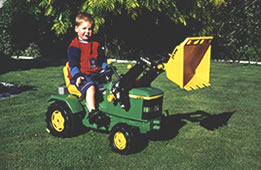
The sixth generation, maybe a farmer and contactor, Daniel James Hadfield, Age 3... For more Hadfield Family history, please click here to go to the history web site. |
|||||||||
 |
||||||||||

|
||||||||||
 |
||||||||||

|
||||||||||
|
||||||||||